- AI
- Products
A general AI assistant vs a product built with AI: what Batayan adds
You can ask a general AI assistant a legal question for free. So why build Batayan? Because a model is only one part of a product. Here is what the rest does: sources, rules, a review step, and someone accountable for the answer.
3rdLoop Solutions
· 5 min read · Updated
Anyone can open a general-purpose AI assistant and ask it a legal question. It will answer in seconds, in clear language, and often in Taglish if you ask in Taglish. For many questions, the answer will be right.
So a fair question for us is: why build Batayan, an AI legal assistant for Philippine businesses, when a general assistant is already on everyone’s phone?
The short answer is that a model is not a product. A general assistant gives you the model and leaves the rest to you. A product built with AI decides where the answers come from, what happens when the system is unsure, who checks the work, and who is accountable when it matters. This article explains that difference, using Batayan as the example.
What a general assistant is good at
General assistants are impressive, and we use them every day. They are good at:
- Starting from nothing. Drafting an email, outlining a proposal, or explaining an unfamiliar term.
- Breadth. They know a little about almost everything.
- Low cost. Many are free or cheap to try.
- Thinking out loud. They help you frame a problem before you take it to someone who can solve it.
If your question is low stakes, or you already know enough to check the answer, a general assistant is often the right tool.
What it leaves to you
A general assistant is built to answer anyone about anything. That means it can’t make the choices a specific job needs. You make them instead, usually without noticing:
- You decide whether to trust the answer. It may sound equally confident whether it is right or wrong.
- You check the sources. If it gives a citation, you still need to confirm that the law exists, is still in force, and says what the answer claims.
- You remember the context. Your contracts, your deadlines, and your earlier questions live in scattered chats.
- You carry the risk. If you act on a wrong answer, no one else reviewed it.
For a lot of work, that is a fine trade. For a lease you are about to sign or a notice you have to answer by Friday, it isn’t.
What a product adds on top of the model
Batayan uses large language models too. The difference is everything we built around them.
Where the answer comes from
A general assistant answers mostly from what it absorbed during training, which covers the whole internet. Philippine law is a small slice of that.
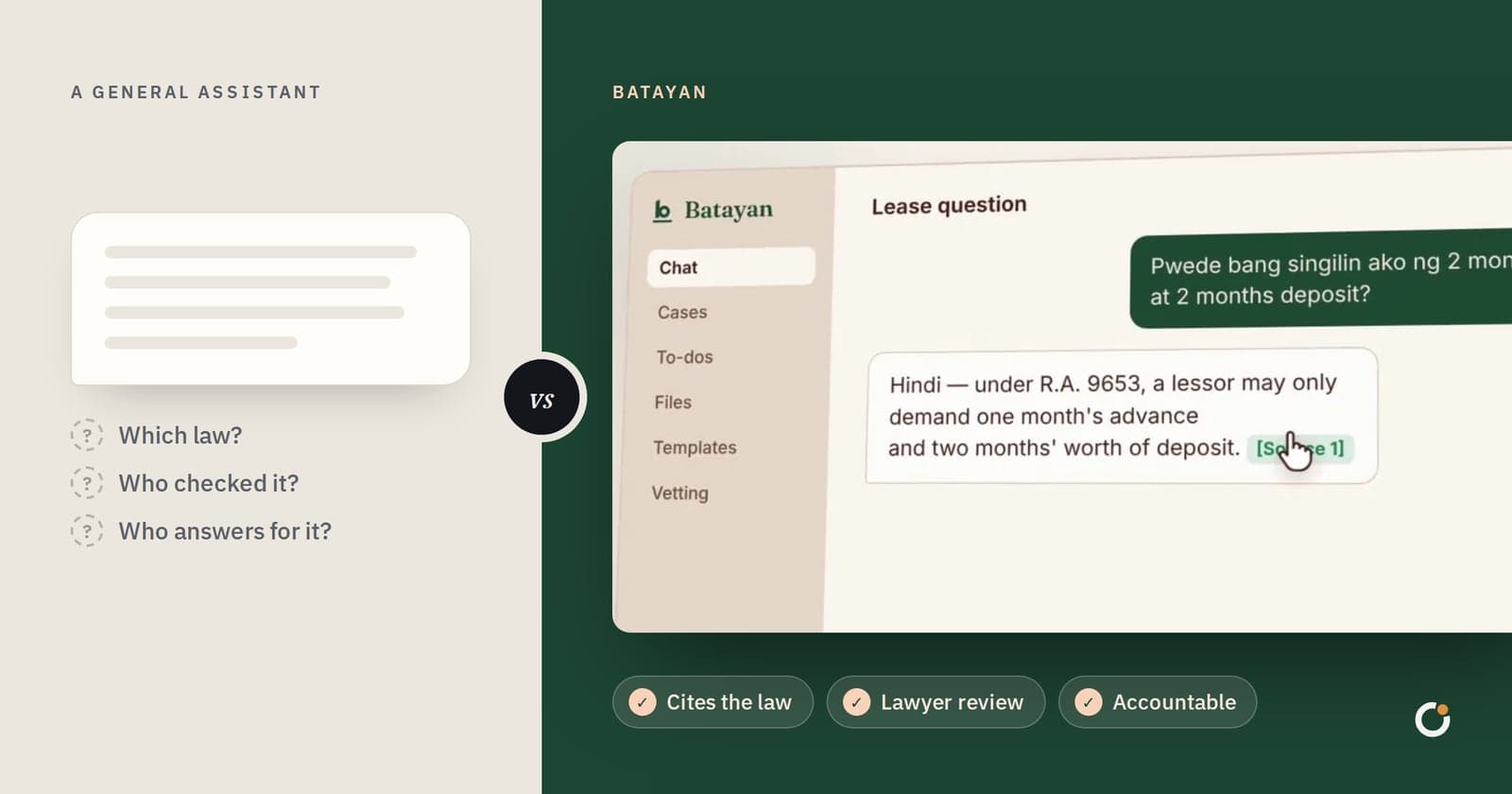
Batayan answers from Philippine sources: the Civil Code, Republic Acts such as R.A. 9653 (the Rent Control Act), and Supreme Court rulings. It retrieves the relevant sources first, then drafts the answer from them. Every claim links to the law or ruling it came from, and the source cards stay in view next to the answer, so you can read the text yourself.
Our rule is simple: no source, no claim.
What happens when it doesn’t know
A general assistant is trained to be helpful, so it tends to fill gaps. That is where invented cases and outdated rules come from.
Batayan states the gap instead. If the sources don’t cover your question, the answer says so and doesn’t guess. A clear “we couldn’t find a basis for this” is more useful than a confident paragraph you can’t rely on.
Who checks the work
This is the biggest difference. In a general assistant, the only reviewer is you.
In Batayan, each question gets a risk level. Routine questions, such as what a term means or which law applies, get a cited answer right away. When the question touches something consequential, such as a signed contract, a termination, or a filing, the system doesn’t advise alone. It escalates to a licensed lawyer, with your question, the sources, and the draft attached. Before you sign a document, a lawyer reviews it.
We call this keeping a human in the loop: the software does the research and drafting, and a qualified person owns the decision.
Where the work lives
A general assistant is a chat window. When the chat ends, the context is gone or buried.
Batayan is a workspace. Your cases, drafts, contracts, and HR documents stay together, and the system tracks the deadlines attached to them. The next question you ask starts from what is already on file, not from a blank page.
Who is accountable
When a general assistant is wrong, its terms of service put the responsibility on you.
A product built for a specific job can be held to a standard. For Batayan, that standard is written into how it works: answers you can trace, gaps stated, and a licensed lawyer on anything that carries real risk.
Not every AI product earns the difference
Some products are a general assistant with a new logo and a different prompt. Before you pay for any AI product, legal or not, ask:
- Where do the answers come from? A named, curated set of sources, or “the model”?
- Can I see the evidence? Does every answer link to the document, clause, or record it relies on?
- What happens when it isn’t sure? Does it say so, or does it guess?
- Who reviews the consequential decisions? Is there a qualified person, and when do they step in?
- Who is accountable? If the product gets it wrong, what is the process to fix it?
If a product can’t answer these clearly, you are paying for a general assistant in a different wrapper.
The bottom line
A general assistant is a powerful, general tool. Use it to draft, to learn, and to think. When the answer has consequences, you need more than the model. You need the right sources, an honest answer when the sources run out, and a person who reviews the work before you act on it.
That is what we built into Batayan. It is how we build all of our products: software handles the routine work within limits you set, escalates what matters, and leaves consequential decisions with a person.
Batayan launches on October 25. Join early access to be first in. If you want to build the same kind of system for a workflow in your own organization, contact us.
Batayan provides legal information and document support. It doesn’t replace advice from your own lawyer on your specific situation.