- Guide
- 3C
How to start a company in the Philippines: SEC, Mayor’s permit, BIR, and the rest
A founder’s guide to registering a company in the Philippines, in the order you will actually do it: your business address, the SEC, the barangay and Mayor’s permit, the BIR, then SSS, PhilHealth, and Pag-IBIG. Plus when a One Person Corporation makes sense, and what it costs you later.
3rdLoop Solutions
· 9 min read
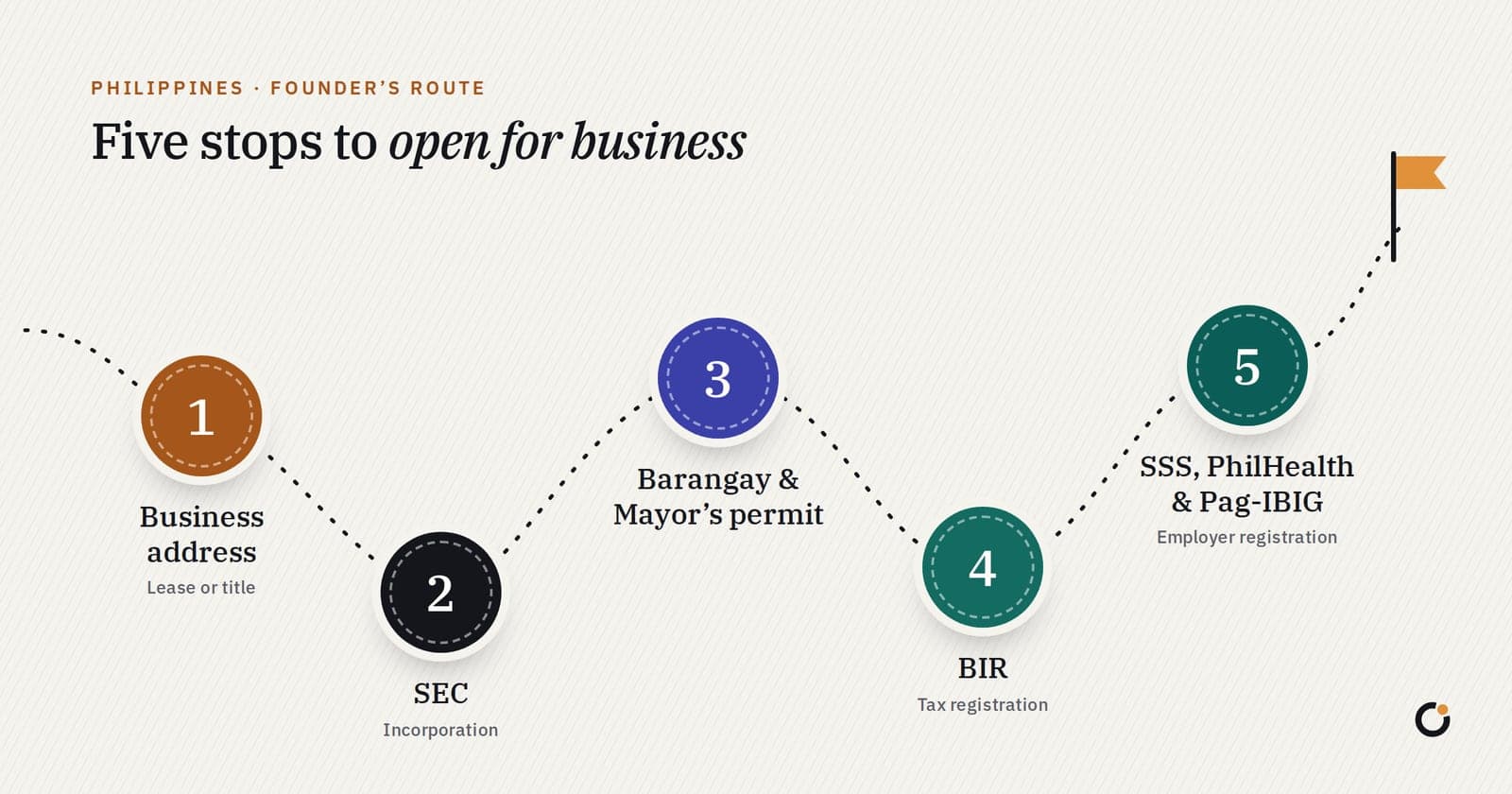
Most founders in 3C ask the same question once the idea starts to feel real: what do we actually have to register, and in what order? The answer is spread across the SEC, the BIR, your city hall, and three social agencies, each with its own forms and its own website.
This guide puts it in one place, in the order you will do it. We went through the same steps when we registered 3rdLoop Solutions with the SEC.
This is a general guide, not legal or tax advice. Fees, forms, and deadlines change, and every city and municipality runs its own permit process. Check with the agency, or with a licensed accountant or lawyer, before you file.
First, check that the SEC is the right place
Not every business registers with the SEC. Where you go depends on the kind of business you are forming:
- Sole proprietorship (one owner, no separate company): register the business name with the DTI, not the SEC. You are personally liable for the business’s debts.
- Partnership, corporation, or One Person Corporation: register with the SEC.
- Cooperative: register with the Cooperative Development Authority (CDA).
If you want a company that is separate from you, that can take in co-founders and investors, and that protects your personal assets, you want a corporation, and that means the SEC. The rest of this guide assumes that.
Corporation or One Person Corporation?
You don’t need five founders anymore
Many founders still believe a corporation needs five incorporators. That was the rule under the old Corporation Code. The Revised Corporation Code of 2019 (Republic Act No. 11232) removed the minimum. A regular stock corporation can now be formed by two to fifteen incorporators, and a single person can form a One Person Corporation (OPC).
So if you have one co-founder, you can already form a regular corporation. If you are building alone, you can form an OPC.
What an OPC is
An OPC is a corporation with a single stockholder. That stockholder must be a natural person, a trust, or an estate. You are automatically the sole director and the president, the company name must end in “OPC,” and there are no board or stockholder meetings to hold. Decisions are recorded as written resolutions instead.
It gives a solo founder limited liability without having to find a second stockholder just to fill a form.
The downsides of an OPC
An OPC is convenient to start, but it has real costs later. Know them before you choose it.
- Adding a co-founder or an investor means converting first. An OPC has exactly one stockholder. The moment you want to give shares to a co-founder, raise from an angel, or set aside an employee stock pool, you have to convert the OPC into a regular corporation with the SEC. Most investors and accelerators will ask you to do that before they put money in.
- Your personal assets are easier to reach. In an OPC, if a creditor sues, you carry the burden of proving that the company was adequately funded and that its property is separate from yours (Section 130 of the Revised Corporation Code). If you mix personal and company money, you may lose the limited liability that was the reason you incorporated.
- You still need other people. You must name a nominee and an alternate nominee, with their written consent, to run the company if you die or become incapacitated. You must also appoint a corporate secretary who is not you.
- Being your own treasurer takes a bond. You may act as treasurer, but you have to post a bond with the SEC and renew it every two years, and undertake in writing to manage the company’s funds properly.
- The SEC watches OPCs more closely now. In March 2026, the SEC tightened the rules on OPCs through Memorandum Circular No. 10, Series of 2026. OPCs must report their officers on time, file audited financial statements every year, and disclose transactions between the company and its owner. Missing the officer report carries a penalty.
- Some businesses can’t be OPCs at all. Banks, quasi-banks, pre-need, trust and insurance companies, public and publicly listed companies, and non-chartered government corporations cannot be OPCs. You also cannot use an OPC to practice a licensed profession, such as law or accounting, unless a special law allows it.
Which should you choose?
- Choose a regular corporation if you have a co-founder, plan to raise money, or want to offer shares to early employees. It saves you a conversion later.
- Choose an OPC if you are building alone, expect to stay that way for a while, and want limited liability now. Keep company money in a company bank account from day one.
If the only thing stopping you from forming a regular corporation is that you don’t have a co-founder yet, that is what co-founder matching in 3C is for.
Step 1: Settle your business address
Your principal office address goes into your Articles of Incorporation, so decide it before you file with the SEC. It matters more than it looks:
- The city or municipality of that address issues your Mayor’s permit and collects your local business taxes.
- The BIR Revenue District Office (RDO) that covers that address is where you register and file.
- Moving later is work. You amend your Articles with the SEC, transfer your RDO with the BIR, and get a new Mayor’s permit in the new city.
Using your home address is possible, but many subdivisions, condominiums, and residential zones restrict business use, and your LGU may inspect the address before it issues a permit.
We recommend a virtual office
Most early companies don’t need a full office, but they do need an address they can put on their registrations. We recommend getting a virtual office. It gives you a business address in a commercial building to use on your SEC, BIR, and Mayor’s permit registrations, along with mail handling and the lease or service agreement those offices ask for, for far less than renting a space.
Before you sign with a provider, confirm that the address can be used for business registration in that city, and ask which documents they give you for the SEC, the BIR, and your LGU.
Step 2: Register with the SEC
SEC registration is done online through eSPARC, the SEC’s company registration portal. Under the SEC’s Zuper Easy Registration Online (ZERO) system, you no longer print, wet-sign, or notarize the registration documents.
- Reserve your company name on eSPARC. Have a few options ready in case your first choice is taken or too close to an existing name.
- Prepare your Articles of Incorporation and By-laws. These set out your purpose, principal office address, capital, incorporators, and directors. The Revised Corporation Code sets no general minimum capital, but some industries, and companies with foreign owners, have their own requirements.
- Submit and pay the registration fees online.
- Receive your Certificate of Incorporation. Your company now legally exists.
For an OPC, you also name your nominee and alternate nominee in the Articles, then appoint and report your treasurer, corporate secretary, and other officers soon after incorporation.
After incorporation, the SEC expects a General Information Sheet (GIS) listing your officers, directors, and beneficial owners, and an annual GIS and annual financial statements every year after that.
Step 3: Get your barangay clearance and Mayor’s permit
With your SEC certificate in hand, go local.
- Barangay business clearance from the barangay where your office is.
- Mayor’s permit (business permit) from the Business Permits and Licensing Office (BPLO) of your city or municipality. Many cities now accept applications online.
Requirements differ by LGU, but expect to be asked for:
- Your SEC Certificate of Incorporation, Articles, and By-laws
- Your barangay clearance
- Your lease contract or virtual office agreement, or proof that you own the space
- A community tax certificate (cedula) for the corporation
- A zoning or locational clearance
- A fire safety inspection certificate from the Bureau of Fire Protection
- A sanitary permit, if your business handles food or health products
Your Mayor’s permit renews every year. Local business taxes are due within the first twenty days of January, and late renewals carry surcharges. Put it in your calendar now.
Step 4: Register with the BIR
Your corporation registers with the BIR RDO that covers your business address, using BIR Form 1903 for corporations and partnerships. You can apply through the BIR’s Online Registration and Update System (ORUS).
Expect to submit your SEC Certificate of Incorporation, Articles, and By-laws, and your Mayor’s permit. If your permit is still being processed, the BIR generally accepts proof that you have applied for it, so many founders run Steps 3 and 4 side by side.
What you get and what you set up:
- Certificate of Registration (BIR Form 2303). It lists the taxes your company must file. Since the Ease of Paying Taxes Act, there is no more ₱500 annual registration fee, and the certificate no longer needs yearly renewal. You still pay a ₱30 documentary stamp tax.
- Books of accounts. Register them before you use them, whether manual, loose-leaf, or computerized.
- Invoices. Under the Ease of Paying Taxes Act, the invoice is now the main document for sales of both goods and services, replacing the official receipt. Get your invoices printed by a BIR-accredited printer, or register your invoicing system.
- Display requirements. Post your Certificate of Registration and the BIR’s notice reminding customers to ask for an invoice where customers can see them.
From here, your company files tax returns on schedule, even in months with no sales. A zero return filed on time costs nothing. A missed one costs penalties.
Step 5: Register as an employer with SSS, PhilHealth, and Pag-IBIG
Once you hire your first employee, register your corporation as an employer with all three agencies:
- SSS, for social security. Register online through the My.SSS employer portal.
- PhilHealth, for health insurance.
- Pag-IBIG Fund, for housing savings.
Each gives you an employer number. From then on you register each new hire, deduct their share from payroll, add the employer share, and remit all three every month.
Don’t wait until payroll to do this. Some LGUs also ask for proof of SSS, PhilHealth, and Pag-IBIG registration when you renew your Mayor’s permit.
Your checklist
- Choose your structure: regular corporation (two or more founders) or OPC (just you).
- Settle your business address. Set up a virtual office if you don’t have a space yet.
- Reserve your company name on eSPARC.
- File your Articles of Incorporation and By-laws with the SEC and pay the fees.
- Receive your SEC Certificate of Incorporation. File your GIS.
- Get your barangay clearance.
- Apply for your Mayor’s permit.
- Register with the BIR using Form 1903, then set up your books of accounts and invoices.
- Open a company bank account and keep company money in it.
- Register as an employer with SSS, PhilHealth, and Pag-IBIG before your first payroll.
- Put the recurring deadlines in your calendar: tax returns, the annual GIS and financial statements, and your Mayor’s permit renewal every January.
Where 3C fits
Registration makes your company official. It doesn’t tell you what to build or who to build it with.
3C is our free startup workspace for Filipino founders. The playbook takes you from idea to company one step at a time, co-founder matching helps you find the people who will sign your Articles with you, and the workspace keeps your projects, pipeline, and numbers in one place once the company is running. When you apply to an accelerator batch, that record shows what you have done.
3C is opening to founders in stages. Request early access and tell us what you are building.